

Holiday Burnout Is Real: Mental Health Strategies for Parents, Students, and Professionals in Ottawa
Summary
From the outside, the holidays look magical: twinkling lights on Elgin Street, crowded farmer markets at Lansdowne, office potlucks, school concerts, and family gatherings. But behind the scenes, many people in Ottawa are running on empty. Parents are pulled between work, school events, and traditions they feel pressured to uphold. Univeristy students are wrapping up exams and navigating identity or family stress. Professionals are closing out year-end targets while trying to be present at home. Newcomers may be experiencing their first Canadian winter while missing loved ones and familiar rituals.
This article explores why holiday burnout is so common, especially between November and January, and how it shows up in the lives of parents, students, and professionals in Ottawa. It also offers practical, evidence-informed strategies you can start using right away—and guidance on when support like counselling in Ottawa might help you move from “surviving the holidays” to feeling more grounded and connected.
Key Highlights
- Why holiday burnout intensifies between November and January
- How stress affects parents, students, professionals, and newcomers differently
- Early signs of burnout to watch for before it escalates
- Evidence-informed strategies to reduce overwhelm and restore balance
- When to consider counselling support and how therapy can help
Holiday Burnout: When “Festive” Becomes Exhausting
Holiday burnout is more than just being a bit tired after a busy week. It’s a deeper emotional and physical exhaustion that builds when demands keep increasing while your energy doesn’t. You might notice that the season you’re “supposed” to enjoy begins to feel like one long obligation.
There are many reasons this happens. The cost of travel, gifts, outings, and special meals can strain any budget, especially in an already expensive city. Workplaces often push hard to finish projects and meet annual targets before the new year. Parents may feel responsible for creating memories their children will cherish, even when they’re drained themselves. Students might be writing final exams at the same time they’re expected to show up at family events.
On top of that, the season acts like an emotional amplifier. If you’re grieving, estranged from family, questioning your identity, or adjusting to life in a new country, holidays can sharpen those feelings. You may find it helpful to read more about coping with loss and grief over the holiday season. Shorter days and cold weather can also exacerbate low mood or seasonal depression for some people. When all of this converges, even small tasks can start to feel overwhelming.
How Holiday Burnout Shows Up in Different Lives
At Family-Therapy™ in Ottawa, our therapists regularly support people who are struggling with stress, anxiety, relationship strain, and life transitions. The holiday period tends to heighten these struggles in different ways depending on the person’s stage of life and responsibilities.
Parents and Caregivers
For many parents, the holiday season is a logistical marathon. On top of regular workdays, there are school concerts, holiday parties, special meals, and gift shopping. There may be pressure to coordinate with co-parents, in-laws, or blended families. Even when it’s done with love, the mental load of “remembering everything” can quietly erode a parent’s capacity.
It’s very common for parents to feel guilty for not doing more—more events, more gifts, more magic. However, to do that, they often have to sacrifice rest, personal time, or even their own emotional needs to hold everything together. Some notice they are snapping more at their partner or kids, then criticizing themselves afterward, reinforcing a painful cycle.
Students and Young Adults
For students and young adults in Ottawa, the holidays can feel like two worlds colliding. One world is academic: exams, final projects, and the pressure to keep grades up. The other world is personal: going home (or choosing not to), facing questions about school, relationships, and identity, and managing family expectations.
If a student is exploring their gender identity or sexual orientation, going home can be especially stressful if their family doesn’t fully understand or accept them. They may find themselves shrinking or masking parts of who they are just to keep the peace. At the same time, they might feel guilty for not feeling “grateful enough” or festive.
Professionals and High-Stress Workers
Professionals in high-responsibility roles often feel that the year’s final quarter is the most intense. There are tight deadlines, performance reviews, and expectations—unspoken or explicit—to finish strong. Many people tell themselves they’ll rest “after this project” or “in January,” but the body and mind often can’t wait that long.
It’s common for work emails to intrude on family dinners, for laptops to open after children go to bed, and for tension to build when partners feel emotionally unavailable to one another. Some professionals turn to coping strategies that offer short-term relief, like extra caffeine, late-night scrolling, or substance use but ultimately leave them feeling more depleted.
Newcomers and People Adjusting to Change
For newcomers and refugees, the holidays in Ottawa can be emotionally complex. This may be a first winter in Canada, with unfamiliar customs, intense cold, and shorter days. There may be memories of conflict, displacement, or loved ones left behind. While community centres and local organizations offer support, it can still be difficult to know where to seek help or how to talk about mental health in a new cultural context.
On the outside, a newcomer may appear resilient and capable. Inside, they might feel lost, lonely, or guilty for struggling at all when they’re “supposed” to be grateful for safety and opportunity.
Recognizing Holiday Burnout in Yourself
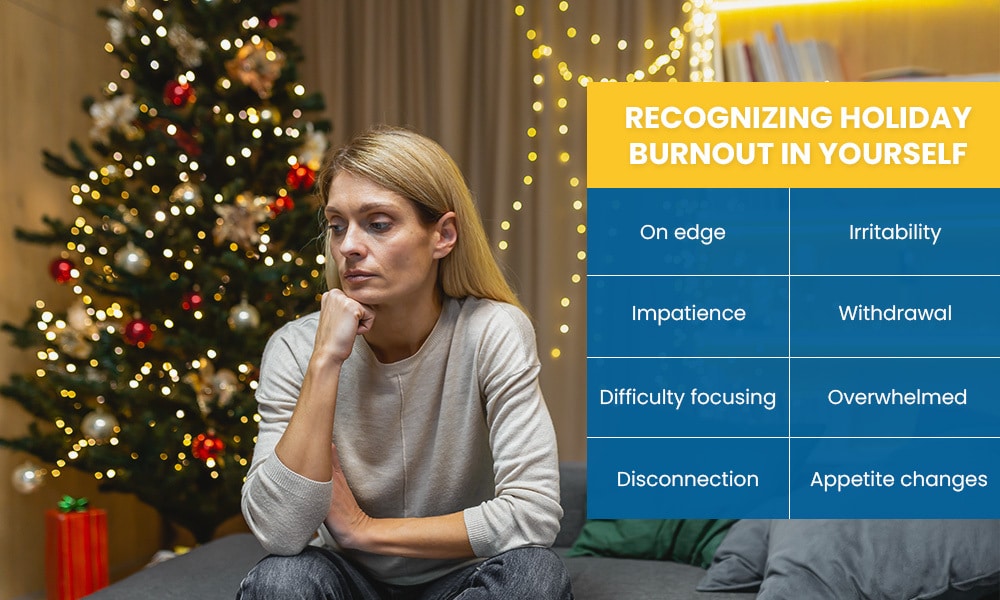
Holiday burnout will present differently for everyone, but there are certain common patterns that we see in therapy sessions. You might notice that you feel constantly “on edge” or that even small tasks, like replying to a text or choosing a gift, feel heavier than they should.
You may find yourself more irritable with the people you care about. You might be short with your children, impatient with your partner, or withdrawn from friends. For students, focusing on lectures or studying might suddenly feel impossibly hard. For professionals, tasks that were once routine may start to feel like climbing a mountain.
Sleep often becomes disrupted—either you’re sleeping too little, waking up repeatedly, or using sleep as an escape. Appetite can change in either direction. Some people notice they’re reaching more often for coffee, alcohol, food, or other ways to numb the discomfort.
Perhaps most quietly of all, there’s the feeling of disconnection. You might look around at a gathering and feel like you’re watching your life from the outside, or you might scroll through social media and feel increasingly distant from the joy you see in others’ posts. These are not signs of failure; they’re signals that your nervous system is overloaded and in need of support.
Small Shifts That Make a Big Difference
While we can’t eliminate every stressor, especially around the holidays, there are meaningful changes you can make that protect your mental health. If you’re looking for more ideas, you might also like our article on practical ways to ease holiday stress.
These are the kinds of strategies Family-Therapy™ therapists often help clients adapt to their specific situations and values.
Start with Boundaries That Honour Your Limits
A helpful place to begin is by honestly acknowledging your limits. You might not be able to attend every gathering, host every event, or buy for every person. It is okay to choose.
- For a parent, that could mean deciding that this year, one or two key traditions matter most, and the rest can be optional.
- For a student, it might mean blocking out certain evenings strictly for rest, even if friends are inviting you out.
- For a professional, it might involve communicating clearly with colleagues about your availability and actually following through on the times you say you will be offline.
Boundary-setting is not selfish; it’s a way of protecting your ability to show up more fully where it matters most.
Simplify the Season Where You Can
Many people discover that when they simplify their holiday plans, they experience more genuine moments of connection. Choosing a modest gift budget, sharing the responsibility of cooking, or opting for a quiet evening at home instead of attending yet another event can reduce stress significantly.
Families sometimes find it helpful to sit down and ask, “What do we actually want this season to feel like?” The answers are often things like “calm,” “together,” or “less rushed,” which rarely come from packing the calendar to the brim.
For newcomers or those adjusting to a new phase of life, creating a few small rituals, such as lighting a candle, cooking a traditional dish, or taking a nightly winter walk, can help the season feel more grounded and meaningful instead of overwhelming.
Put Rest on the Calendar, Not Just Your To-Do List
Rest is often treated like a luxury, something you only get after everything else is done. However, mental health research and clinical experience both point to rest as a fundamental need, especially when stress is high.
Consider scheduling rest the way you’d schedule a meeting: a 15-minute break to step away from your screen, a slow morning on one weekend day, or a tech-free evening with a book or a warm drink. These pauses give your body and mind a chance to reset instead of operating in constant overdrive.
For students or professionals, even brief grounding practices such as deep breathing, a short mindful walk, or progressive muscle relaxation can shift your nervous system out of “fight or flight” and reduce burnout over time.
Practice Self-Compassion Instead of Self-Criticism
Many people carry a running internal monologue that is harsh and unforgiving: I should be handling this better. Everyone else seems fine. I’m failing my kids / my partner / my parents / my job.
Our therapists at Family-Therapy™ often help clients build self-compassion, which means responding to yourself with kindness instead of judgement. Imagine how you would speak to a close friend who is exhausted and overwhelmed, then try offering yourself even a fraction of that warmth.
You might say to yourself, “Of course this feels hard, there’s a lot on my plate,” or “I’m learning my limits and that’s okay,” or “I can’t do everything, but I can choose what matters today.” This simple shift reduces shame and creates space for healthier choices.
You don’t need to overhaul your entire life in January. Gentle, realistic changes are more sustainable than harsh “all or nothing” resolutions. If you’re thinking about next steps, our blog on five realistic tips for New Year’s resolutions can help you choose changes that respect your mental health.
Lean on Community and Support
Isolation fuels burnout. Connection softens it.
Support can look like many things: confiding in a partner, reaching out to a trusted friend, joining a newcomer group, attending an LGBTQ+ support circle, or reconnecting with a faith or cultural community that feels safe. For some, it’s about being honest with colleagues about feeling stretched thin. For others, it’s about finally saying to a therapist, “I can’t keep doing this alone.”
When you turn toward support instead of away from it, you send yourself the powerful message that your well-being matters.
When It’s Time to Reach Out for Professional Help
It’s not always obvious where the line between “holiday stress” and “I might need therapy” lies. A helpful guideline is to look at how long you’ve been struggling and how much it’s affecting your ability to function day-to-day.
If anxiety, low mood, or irritability have been lingering for weeks; if you’re finding it hard to concentrate or complete normal tasks; or, if your relationships are suffering, it may be time to consider speaking with a mental health professional. If you’re noticing trauma memories resurfacing, identity-related stress intensifying, or reliance on substances or numbing behaviours increasing, these are also signs that extra support could really help.
Therapy is not a sign that you are broken. It is a structured, supportive space where you can unpack what’s happening, understand why you’re feeling the way you do, and develop strategies that fit your life. For many people, connecting with therapists in Ottawa who understand the realities of local work culture, school pressures, family systems, and immigration experiences makes the process feel more grounded and relevant.
How Family-Therapy™ Can Support You Through the Holidays and Beyond
Family-Therapy™ is built on the belief that people don’t need to face overwhelming seasons alone. The practice offers individual, couples, and family therapy, with a strong emphasis on creating a safe, welcoming environment for diverse clients: busy parents, students, professionals under pressure, LGBTQ+ folks, newcomers, and people navigating trauma or chronic mental health challenges.
Therapists draw on evidence-based approaches such as CBT, DBT, trauma-informed care, and mindfulness while tailoring their work to each person’s story.
- For a parent, that might look like learning communication tools that reduce tension with a partner and help set realistic expectations at home.
- For a student, therapy may focus on managing anxiety, strengthening identity, and negotiating family expectations.
- For a professional, sessions may support boundary-setting, healthier coping skills, and repairing relationships that have been strained by overwork.
- For a newcomer, therapy might offer a culturally sensitive space to process trauma, grief, and the complex emotions of adapting to a new country.
Family-Therapy™ offers flexible booking options, including virtual sessions, which can be especially helpful in the winter months or for people with tight schedules. Taking the first step might be as simple as visiting the website, exploring the team, and booking an initial consultation to see what feels like a good fit.
You don’t have to wait until you “hit a wall.” Support is available now, even if what you’re feeling is “just” exhaustion, irritability, or the sense that you’re not yourself. With the right help, it’s possible not only to get through the holidays, but to rebuild a sense of balance that lasts long after the decorations are packed away.
Whether you prefer to meet in person at our Ottawa office at 4019 Carling Ave, Suite 202, Ottawa, K2K 2A3, or connect virtually, our therapists support individuals and families in Ottawa, Nepean, Stittsville, Barrhaven, Orleans, Carp, and Carleton Place, with online sessions available throughout Ontario.